A urine D/R test is one of the most commonly ordered routine tests in Pakistan. It is a simple urine examination that can give an early clue about urinary infections, kidney problems, diabetes-related changes and some other health issues. Because the test is routine and inexpensive, prices differ from lab to lab — but the difference is usually only a few hundred rupees.
In this guide, we compare the urine D/R test price in Pakistan across all major labs, using the test names exactly as each lab lists them. The prices below are the listed prices as of November 2026. Prices may vary by branch or city, so it is always worth confirming the price at your nearest branch before you visit.
Urine D/R Test Price in Pakistan — Comparison Table
| Laboratory | Test as listed | Price | Source |
|---|---|---|---|
| Chughtai Lab | Urine C/E (Complete, Analysis) | Rs 650* | Chughtai Lab test list |
| Dow Lab | Urine D/R Test | Rs 350 | Dow Lab test list |
| Islamabad Diagnostic Centre (IDC) | Urine C/E (Urine Test) | Rs 750 | IDC test list |
| Ibn-E-Sina Clinical Laboratory | Urine C/E (Urine Test) | Rs 400 | Ibn-E-Sina test list |
| Alnoor Diagnostic Centre | Urine C/E (Urine Test) | Rs 550 | Alnoor test list |
| Khan Lab and Diagnostic Centre | Urine C/E (Urine Test) | Rs 115 | Khan Lab test list |
| Khan Lab and Diagnostic Centre | URINE R/E | Rs 400 | Khan Lab test list |
| Aga Khan University Hospital | Urine D/R | Price not publicly listed — confirm with the hospital | — |
*Chughtai Lab note: the official Chughtai Lab website lists Urine C/E (Complete, Analysis) at Rs 650, while the Chughtai list on this site shows Rs 550. The official price of Rs 650 is used in the table above, and the difference is noted here for transparency.
Dr. Essa Laboratory and Diagnostic Centre is not included in the table because its list on this site does not contain a urine routine entry under the names Urine D/R, Urine C/E or Urine Routine. Its urine culture and urine spot entries are different tests and are therefore not priced in this comparison. A urine culture is a different test from a urine D/R, and it is not priced inside this post’s table unless a lab lists it as part of the named entry — none of the labs above does.
Urine D/R Test Price Summary
Based only on the values in the table above, urine routine test prices in Pakistan range from Rs 115 to Rs 750. The lowest listed price is Rs 115, for Urine C/E (Urine Test) at Khan Lab and Diagnostic Centre, and the highest listed price is Rs 750, for Urine C/E (Urine Test) at Islamabad Diagnostic Centre (IDC). Most labs in the table fall between Rs 350 and Rs 650. Khan Lab’s separately listed URINE R/E entry, at Rs 400, is kept as its own row and is not merged with its Urine C/E entry. Aga Khan University Hospital is shown without a number because its price is not publicly listed; it is not counted in the range above.
What Is a Urine D/R Test?
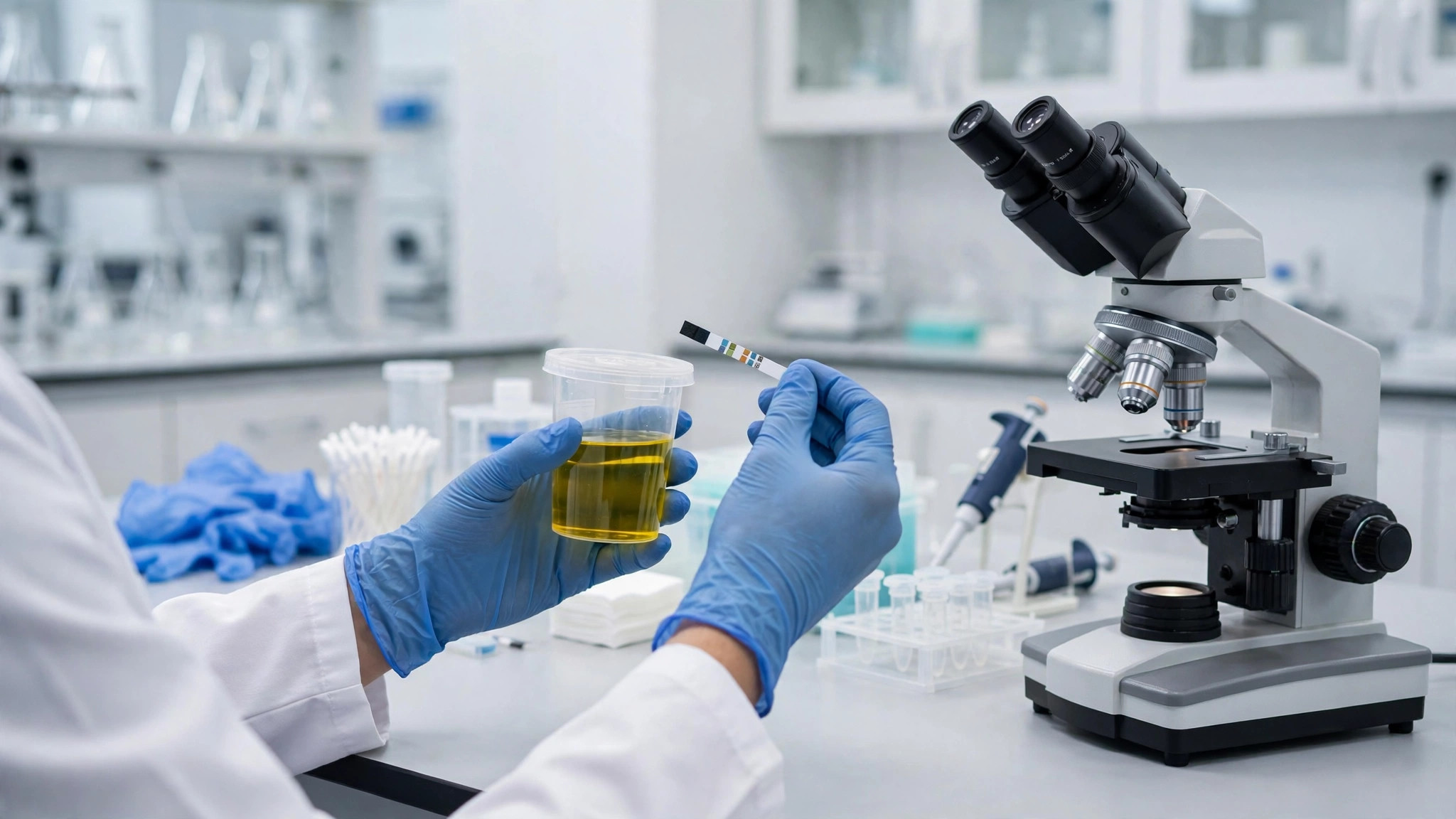
Urine D/R stands for urine detailed report, and it is the same kind of routine examination that other labs call Urine C/E (complete examination) or Urine R/E (routine examination). The different names describe the same basic idea: a routine check of a urine sample. In plain words, the test looks at the urine’s appearance and colour, and checks for things such as protein, sugar, blood cells, pus cells, crystals and other substances that should not normally be present in large amounts. It is a screening test — it can point towards a problem, but it does not by itself give a final diagnosis.
Why Do Doctors Order a Urine D/R Test?
Doctors commonly order this test as general information in situations such as:
- Urinary symptoms, for example burning while passing urine, frequent urination, pain, or cloudy or blood-stained urine.
- A fever workup, where the doctor is checking whether a urinary infection could be part of the illness.
- Routine screening, for example during a general health check or before a procedure.
- Pregnancy checks, where routine urine testing is a normal part of antenatal care.
It may also be ordered to follow up a known kidney or urinary problem, or alongside other routine tests. For comparison, see our CBC test price comparison, another routine test that is often ordered at the same time.
How Is the Sample Collected? Preparation
The following is general information only; always follow your own lab’s instructions.
- The sample is usually collected as a clean-catch midstream sample. This means cleaning the area first, starting to pass urine, and then collecting the middle part of the stream in the sterile container provided by the lab.
- A first morning sample is often preferred, because it is more concentrated, but your doctor or lab may accept a sample at another time of day.
- Collect the sample in the container given by the lab, close it properly, and hand it in promptly as instructed.
- No special fasting is normally required for a routine urine test, but tell your doctor or the lab about any medicines you are taking, as some can affect the result.
If you are unsure about the collection method, ask the lab staff before you give the sample — a poorly collected sample can affect the result.
Urine D/R Reference Ranges (General Reference Only)
The ranges below are general reference values only. Reference ranges vary from laboratory to laboratory, and from one method to another, so your own report should be read against the range printed on that report. A result outside a general range does not automatically mean you have a disease, and a result inside the range does not rule out every problem — only your doctor, who knows your symptoms and history, can interpret the result properly.
- Appearance: usually clear, pale yellow to yellow.
- Protein: normally negative or absent.
- Glucose (sugar): normally negative or absent.
- Blood: normally negative or absent.
- Pus cells: usually few (often up to about 5 per high-power field in a routine report).
- Red blood cells: normally absent or very few.
- Crystals and bacteria: normally absent or only occasional; their presence is interpreted with the other findings.
Abnormal findings need a doctor’s interpretation. For example, pus cells or bacteria may suggest a urinary infection, protein may point towards a kidney issue, and sugar in the urine may be linked to blood sugar problems — but none of these findings alone proves a diagnosis. A doctor may sometimes advise a urine culture, which is a different test that tries to grow and identify any bacteria present, to confirm an infection and guide treatment.
Urine D/R Test Reports
Reports are collected from the lab’s online report portal or collection centre, depending on the lab. The links below are the report guides on this site; no report timings are stated here, as timing can vary by lab and branch:
- Chughtai Lab online reports
- Dow Lab online reports
- IDC online reports
- Ibn-E-Sina Lab online reports
- Alnoor online reports
- Dr. Essa Lab online reports
- Aga Khan Lab online reports
How to Choose a Lab for a Urine D/R Test
Because the price gap is small, price alone is rarely the best reason to choose a lab. Consider instead:
- Distance and convenience — a collection centre near your home or workplace makes it easier to deliver a fresh sample promptly.
- Whether the lab accepts walk-ins or requires booking, and its opening hours.
- How you will receive the report — online, by SMS, or in person — and whether the lab’s report portal works for you.
- Your doctor’s preference, since some doctors prefer reports from a particular lab for follow-up comparisons.
- The total cost, including any home sample collection charges, which may be separate from the test price.
For city-wise price comparisons, see our guides to lab test prices in Karachi, lab test prices in Lahore and lab test prices in Islamabad.
Frequently Asked Questions (FAQs)
What is the urine D/R test price in Pakistan?
Based on the table above, listed urine routine prices range from Rs 115 to Rs 750, depending on the lab and the exact entry name. The official Chughtai Lab price used here is Rs 650. Prices may vary by branch or city.
Is a urine D/R test the same as urine C/E or urine R/E?
Yes, in general use these names describe the same kind of routine urine examination. Labs simply use different short forms: D/R (detailed report), C/E (complete examination) and R/E (routine examination). This post keeps each lab’s exact listed name as a separate row rather than silently merging different entries.
Is a first morning sample necessary?
A first morning sample is often preferred because it is more concentrated, but it is general guidance only — your lab may accept a sample at another time. Follow your lab’s instructions.
Is a urine culture the same as a urine D/R test?
No. A urine D/R (or C/E) is a routine examination of the urine sample, while a urine culture is a different test that tries to grow bacteria from the sample. A doctor may order a culture after an abnormal routine result, but the culture is not included in this post’s price table.
What should I do if my urine D/R result is abnormal?
Do not try to diagnose yourself from a single result. Take the report to your doctor, who will read it with your symptoms, examination and any other tests, and decide whether further testing or treatment is needed.
All Lab Tests is an independent information guide and is not affiliated with Chughtai Lab, Dow Lab, IDC, Ibn-E-Sina, Alnoor, Khan Lab or Aga Khan University Hospital. Prices are listed prices as of November 2026 and may vary by branch or city. This article is for general information only and is not medical advice. Always consult a qualified doctor for diagnosis, treatment, or interpretation of your test results.
Last updated: November 2026