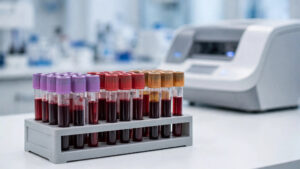

CRP, or C-reactive protein, is a blood test that measures inflammation in the body. When there is infection or inflammation, the liver makes more CRP, so the level in the blood rises. Doctors use it as a general marker — it shows that inflammation is present, but it does not by itself say what is causing it.
In this guide, we compare the CRP test price in Pakistan across all major labs, using the test names exactly as each lab lists them. One important distinction runs through the whole comparison: labs list both standard CRP and High Sensitive CRP (hs-CRP), and these are different entries. They are kept in separate tables below and are never merged. The prices below are the listed prices as of November 2026. Prices may vary by branch or city, so confirm the price at your nearest branch before you visit.
Standard CRP Test Price in Pakistan — Comparison Table
| Laboratory | Test as listed | Price | Source |
|---|---|---|---|
| Chughtai Lab | Serum CRP | Rs 2,800* | Chughtai Lab test list |
| Dow Lab | CRP (C-REACTIVE PROTEIN) | Rs 1,060 | Dow Lab test list |
| Islamabad Diagnostic Centre (IDC) | CRP (C-REACTIVE PROTEIN) | Rs 2,000 | IDC test list |
| Ibn-E-Sina Clinical Laboratory | CRP (Qualitative) | Rs 900 | Ibn-E-Sina test list |
| Khan Lab and Diagnostic Centre | CRP (Quantitative) | Rs 1,000 | Khan Lab test list |
| Aga Khan University Hospital | CRP | Price not publicly listed — confirm with the hospital | — |
*Chughtai Lab note: the official Chughtai Lab website lists Serum CRP at Rs 2,800, while the Chughtai list on this site shows Rs 2,500. The official price of Rs 2,800 is used in the table above, and the difference is noted here for transparency.
High Sensitive CRP (hs-CRP) Test Price in Pakistan — Separate Table
High Sensitive CRP is a different test from standard CRP. It measures very low levels of CRP, and it is often used for heart-risk assessment. Its prices are therefore shown separately, and no hs-CRP price has been merged into a standard CRP row above.
| Laboratory | Test as listed | Price | Source |
|---|---|---|---|
| Islamabad Diagnostic Centre (IDC) | CRP (High Sensitive) | Rs 2,400 | IDC test list |
| Ibn-E-Sina Clinical Laboratory | CRP (High Sensitive) | Rs 1,800 | Ibn-E-Sina test list |
| Alnoor Diagnostic Centre | CRP (High Sensitive) | Rs 2,500 | Alnoor test list |
| Aga Khan University Hospital | CRP (High Sensitive) | Price not publicly listed — confirm with the hospital | — |
Dr. Essa Laboratory and Diagnostic Centre is not included in either table because no CRP entry — standard, quantitative, qualitative or high sensitive — was found on its list on this site. Alnoor Diagnostic Centre appears only in the hs-CRP table because its list contains a high sensitive entry but no standard CRP entry. Chughtai Lab, Dow Lab and Khan Lab appear only in the standard CRP table because no high sensitive entry was found on their lists.
CRP Test Price Summary
Based only on the values in the tables above, and keeping the two test types separate: standard CRP prices range from Rs 900 to Rs 2,800. The lowest standard CRP price is Rs 900, for CRP (Qualitative) at Ibn-E-Sina Clinical Laboratory, and the highest is Rs 2,800, for Serum CRP at Chughtai Lab at the official rate. High Sensitive CRP prices range from Rs 1,800 to Rs 2,500, from Ibn-E-Sina at Rs 1,800 to Alnoor Diagnostic Centre at Rs 2,500. Aga Khan University Hospital is shown without a number in both tables and is not counted in either range.
What Is a CRP Test?
CRP is a protein made by the liver. Its level in the blood rises when the body is dealing with infection or inflammation, and it usually falls again as the inflammation settles. In plain words, CRP is an inflammation marker: a high result tells the doctor that inflammation is present somewhere in the body, but it does not identify which infection is present or what is causing the inflammation. That distinction matters, and it is stated plainly here because a CRP result on its own cannot diagnose a specific disease.
Standard CRP vs hs-CRP: What Is the Difference?
Standard CRP and hs-CRP measure the same protein, but at different levels of sensitivity. Standard CRP — listed as quantitative, qualitative or simply CRP, depending on the lab — is used when inflammation may be clearly raised, for example during an infection. High Sensitive CRP, or hs-CRP, measures very low levels of CRP that a standard test may not pick up. It is often used for heart-risk assessment, as general information, because even low-grade, long-term inflammation is linked to cardiovascular risk. Which test is needed is a decision for your doctor, who will choose based on why the test is being ordered; do not assume that one can simply replace the other, and do not compare their prices as if they were the same test.
Why Do Doctors Order a CRP Test?
Doctors commonly order CRP as general information in situations such as checking for infection or inflammation, monitoring how an infection or inflammatory condition is responding, and, for hs-CRP, assessing heart risk. CRP is also commonly ordered in fever workups, where it is read together with other tests to build a fuller picture of the illness. For related fever-workup comparisons, see our Dengue test price comparison and our Typhoid test price comparison. A CRP result is always read with symptoms and other tests by a doctor; it is not a standalone diagnosis.
How Is the Sample Taken? Preparation
The following is general information only; always follow your own lab’s instructions.
- CRP is a blood test. A small blood sample is taken from a vein, usually in the arm.
- No special fasting is normally required for CRP, but follow the instructions given by your doctor or lab, especially if other tests are being done at the same time.
- Tell your doctor or the lab about any medicines you are taking, as some medicines and recent illness, injury or surgery can affect inflammation levels.
- Rest briefly before the sample if you have just exercised heavily, and let the lab know about any recent infection or vaccination.
CRP Reference Ranges (General Reference Only)
The wording below is general reference information only. Reference ranges vary from laboratory to laboratory and from one method to another, so your own report should be read against the range printed on that report. Results are read with symptoms and other tests by a doctor, who decides what a result means for you.
- Standard CRP: in general, a level below about 10 mg/L is often described as normal, while higher levels suggest inflammation. The higher the level, the more marked the inflammation tends to be, but the number alone does not name the cause.
- High Sensitive CRP (hs-CRP): in general, a level below 1 mg/L is often described as low risk, 1 to 3 mg/L as average or moderate risk, and above 3 mg/L as higher risk in a heart-risk context. A level well above 10 mg/L usually suggests an infection or a more marked inflammatory process rather than a low-grade risk reading.
Because ranges and units can differ, and because CRP rises for many reasons, an abnormal result needs a doctor’s interpretation and sometimes further testing.
CRP Test Reports
Reports are collected from the lab’s online report portal or collection centre, depending on the lab. The links below are the report guides on this site; no report timings are stated here, as timing can vary by lab and branch:
- Chughtai Lab online reports
- Dow Lab online reports
- IDC online reports
- Ibn-E-Sina Lab online reports
- Alnoor online reports
- Dr. Essa Lab online reports
- Aga Khan Lab online reports
How to Choose a Lab for a CRP Test
First, confirm which test your doctor has ordered — standard CRP or hs-CRP — because the two are different tests with different prices, and not every lab lists both. Then consider:
- Distance and convenience, and whether the lab accepts walk-ins or requires booking.
- How you will receive the report — online, by SMS, or in person.
- Your doctor’s preference, since follow-up comparisons are easier when the same lab and the same test type are used.
- The total cost, including any home sample collection charges, which may be separate from the test price.
For city-wise price comparisons, see our guides to lab test prices in Karachi, lab test prices in Lahore and lab test prices in Islamabad. For another routine comparison, see our CBC test price comparison.
Frequently Asked Questions (FAQs)
What is the CRP test price in Pakistan?
Based on the tables above, standard CRP prices range from Rs 900 to Rs 2,800, and High Sensitive CRP (hs-CRP) prices range from Rs 1,800 to Rs 2,500. The two ranges are kept separate because they are different tests. Prices may vary by branch or city.
What is the difference between CRP and hs-CRP?
Standard CRP measures inflammation when levels may be clearly raised, for example during infection. High Sensitive CRP measures very low levels of CRP and is often used for heart-risk assessment, as general information. Your doctor decides which one is needed.
Does a high CRP result show which infection I have?
No. CRP shows that inflammation is present, but it does not identify which infection or its cause. A doctor reads the result with your symptoms and other tests, and may order further tests to find the cause.
Do I need to fast before a CRP test?
No special fasting is normally required for CRP, but follow your doctor’s or lab’s instructions, especially if other tests are being done at the same time, and tell them about any medicines you are taking.
Why do some labs show a CRP price and others show an hs-CRP price?
Because labs list the tests differently. Some labs list only standard CRP, some list only hs-CRP, and some, such as IDC and Ibn-E-Sina, list both as separate entries. This post keeps each entry in its own table rather than merging them.
All Lab Tests is an independent information guide and is not affiliated with Chughtai Lab, Dow Lab, IDC, Ibn-E-Sina, Alnoor, Khan Lab or Aga Khan University Hospital. Prices are listed prices as of November 2026 and may vary by branch or city. This article is for general information only and is not medical advice. Always consult a qualified doctor for diagnosis, treatment, or interpretation of your test results.
Last updated: November 2026